Online Tajweed Classes in Dallas and Houston | MQI Blog
Online Tajweed Classes – Learn Quranic recitation with expert guidance at Maryam Quran Institute.


Learn Quran Online with Tajweed. Learn Quran and Tajweed. Learn Quran Tajweed. Maryam Quran Institute gives every letter its due.
Your broadband is fast. Videos load in a blink, and a Tajweed lesson plays in HD—nevertheless, your recitation stalls at the same mistakes. A video can’t hear you or stop you at the wrong letter. Meanwhile, your Wi-Fi freezes on a group call, and the lesson drops.
Live feedback fixes this. You can learn Quran online with Tajweed from a live teacher who listens and corrects you. Maryam Quran Institute (MQI) offers one-on-one, 30-minute classes from $25 a month. In short, you get a real, live person on the other end. A one-on-one video call needs very little bandwidth, so most home broadband plans work.
MQI also offers free trial classes, and it asks for no credit card. Below, you get a step-by-step plan to learn Quran and Tajweed at your own pace. A price comparison and a checklist for choosing a teacher follow.

Learning Quran online with Tajweed means studying correct recitation in live video lessons. A teacher corrects each letter’s sound, length, and ending as you recite. Tajweed is the science of reciting the Quran correctly. The word means improvement and mastery, according to SurahQuran.com. SeekersGuidance explains it as giving each letter its due. In other words, you learn where each sound starts and how long it lasts. When you learn Quran online with Tajweed, a teacher shows these rules on video.
The Quran itself points to careful recitation. Quran 73:4 tells the Prophet, peace be upon him, to recite in a measured way. Aisha, radiyallahu anha, reported his words about skilled readers. He said the skilled reciter will be with the noble and righteous scribes. The double reward for the one who struggles is especially comforting for beginners. You can find this hadith in Sahih al-Bukhari 4937.
Scholars discuss the exact ruling, so ask a qualified scholar about your case. Many tajweed teachers say learning the rules is a communal duty. They add that applying the rules in your own recitation is a personal duty. On the other hand, some jurists call tajweed recommended rather than required. Either way, the goal stays the same: recite the way the Prophet taught. Your local imam or a trusted scholar can explain the ruling for you.
The main benefits of learning Tajweed online are live correction, flexible scheduling, and no commute. Online lessons remove the commute. You study from your living room and keep your day free. Besides saving time, you can choose a teacher from anywhere, so distance never limits you. You can also fit lessons around work and family life. Your teacher still hears every word, just through a screen.
Research on online learning gives some support. A 2010 meta-analysis for the US Department of Education compared online and face-to-face classes. Online students performed modestly better. Equally important, the authors urged caution about applying the results to K-12 students. That review also covered many subjects, not Quran recitation. It hints at a benefit, though it says nothing about Tajweed itself.
Tajweed depends on sound, and live video carries sound well. Your teacher hears each throat letter and each stretch as you recite. She corrects you right away, before a mistake becomes a habit. To point out one more gain, one-on-one lessons give every minute of class to you. A group makes you wait your turn. A one-on-one class gives you more time to recite.
A clear order makes learning easier. Your teacher may change the pace to fit you. Generally, students move through four stages, and each stage builds on the last. MQI offers an Online Basic Qaida course for the first steps. It also offers a Quran Reading with Tajweed course for the next stage.
Also Read: Noorani Qaida Online Classes | USA Parents’ Guide
Start with the 28 Arabic letters and their sounds. Scholars group the exit points of the letters into 17 places. These places sit in the throat, tongue, lips, and nose. In particular, many English speakers find the throat letters hard. English has no match for them. Your teacher will model each sound slowly. You then repeat it until it feels natural. Short daily practice works better than one long session.
Once you read letters with vowels, you meet the noon sakinah rules. The rule changes with the letter that follows the noon. Your teacher will drill these with short examples. Subsequently, you practice them in full verses. The table below gives the basic rules, based on the Tajwid entry on Wikipedia.
| Rule | Letters that trigger it | What you do |
| Izhar | ء ه ع ح غ خ (hamza, haa, ayn, hhaa, ghayn, khaa) | Say the noon clearly, with no nasal blend. |
| Idgham | و م ي ل ر ن (waw, meem, yaa, laam, raa, noon) | Merge the noon into the next letter. |
| Iqlab | ب (baa) | Change the noon to a meem sound, with a nasal sound of about two counts. |
| Ikhfa | The remaining letters | Hide the noon softly, with a light nasal sound. |
Counts can differ between recitation styles. Accordingly, follow your teacher’s counts, and use charts only as a memory aid.
Now you add rhythm. A natural stretch, called madd, lasts two counts. Five letters bounce when they carry a sukoon: qaf, taa, daal, jeem, and baa. Scholars call this bounce qalqalah. Your teacher will also show you where to stop. As a result, your reading starts to sound smooth and steady. Your teacher confirms the counts for your recitation style.
You can now learn Quran Tajweed through real recitation. Start with short surahs. Read each verse slowly, and let your teacher stop you at each slip. Eventually, you read longer passages with fewer stops. MQI’s Quran Memorization course focuses on Juz Amma surahs, which give you good practice material.
To improve Tajweed online, record yourself, listen daily, and fix one rule at a time. Lessons give you the rules, and practice makes them stick. Above all, treat the time between classes as part of your course. SeekersGuidance, an Islamic learning platform, shares a few habits in a June 2024 answer. Shaykh Anas al-Musa recommends a proficient teacher, careful listening, recording, and repetition. The tips below build on that advice.

Your phone works as a free teaching aid. Record one verse each day, and then play it back. To illustrate, say you read a verse with a stretch that felt right. On playback, you may hear that it was too short. Mark the spot and ask your teacher about it in the next class.
Listening trains your ear for the right sounds. Pick a skilled reciter your teacher trusts. Play one short passage, and then recite along. Chiefly, listen for how long the reciter holds each stretch and where he pauses. Match the pace before you try to match the voice.
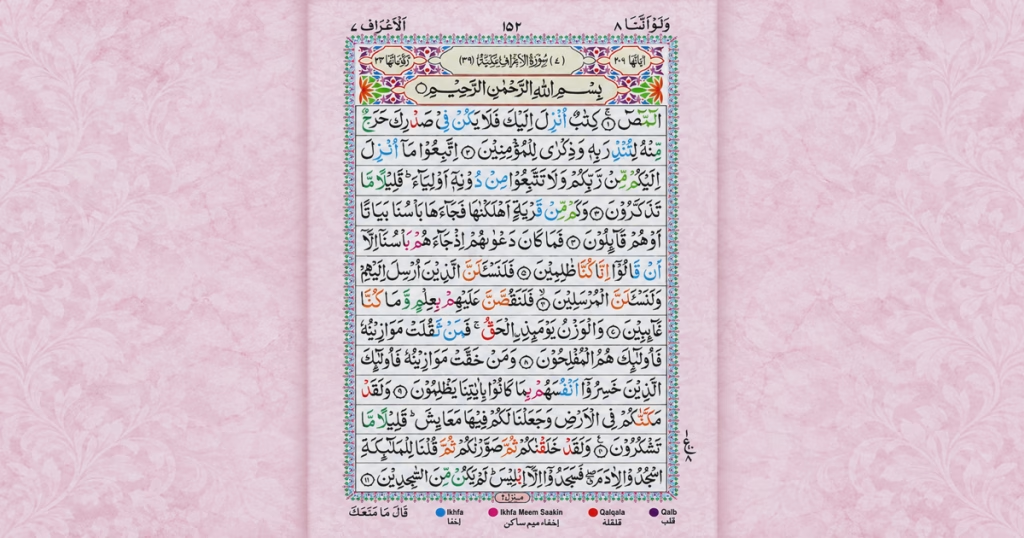
A color-coded Mushaf marks tajweed rules with colors. Charts show where each letter starts in the mouth and throat. SeekersGuidance lists both tools as study aids. Keep both on your desk for this purpose, and check each point with your teacher.
Too many corrections at once can discourage you. Pick one rule for the week, such as the two-count stretch. Most important, practice it until your teacher stops correcting it. Then move to the next rule. Each small fix builds your confidence.
The best Tajweed course offers live one-on-one correction, a clear level path, and a free trial. Your level and goal decide the final pick. At the same time, a famous name does not guarantee good teaching. Use the table below to judge any course, including ours.
| What to look for | Why it matters |
| Live, one-on-one correction | A teacher hears your mistakes and fixes them on the spot. |
| A clear level path | You know what to learn first and what comes next. |
| Qualified teachers | Ask about training, and ask whether the teacher holds an ijazah. |
| A stated recitation style | Rules and counts vary, so the teacher should name the style she teaches. |
| A free trial class | You test the teacher and the platform before you pay. |
| Clear pricing | You can compare the price per class hour. |
| Progress feedback | Notes or a certificate help you track your growth. |
MQI’s Quran Reading with Tajweed course meets several points on this list. Classes are one-on-one and last 30 minutes, and students earn a certificate. Additionally, the pricing page lists every plan in US dollars. You can compare before you book.
Most beginners should start with a Qaida course, then move to Tajweed reading. No single course fits everyone. Because goals differ, the best pick differs too. Match your goal to the course type in the table below.
| Your goal | Course type to look for | MQI course |
| Learn the letters from zero | Letter-based beginner course | Online Basic Qaida |
| Read the Quran with correct rules | Reading course with Tajweed | Quran Reading with Tajweed |
| Memorize short surahs | Memorization course | Quran Memorization (Juz Amma surahs) |
| Understand the meaning in Urdu | Translation course | Quran Translation (Urdu) |
| Study the explanation in Urdu | Tafseer course | Quran Tafseer in Urdu |
Students who learn Quran and Tajweed together often add translation or memorization later. In brief, reading well comes first. MQI also offers a course called Ruju Ilal Quran. Ask the team about its details before you enroll.
The best website for learning Quran online pairs lessons with a live teacher. Compare the type of help each site gives. Videos teach you the rules. A live teacher fixes your mistakes. After all, a live teacher hears your recitation, and a video does not. Pick a site that lets you try it before you pay.
Platforms fall into four groups. Live teachers, group classes, apps, and AI tools all work differently. Hence, compare them by what they give you. The table shows one example of each group, as we found them on October 20, 2026.
| Platform type | Example | What we found | Teacher feedback |
| Live one-on-one academy | Maryam Quran Institute | One-on-one, 30-minute classes. Plans from $25 a month. | Yes, live |
| Live group class | One Qalam | Weekly 90-minute Zoom class for up to 8 students. £50 a month on a 3-month plan. Learners must already read the Quran. | Yes, shared with the group |
| Free app | Learn Quran Tajwid | Free download with 23 topics. Teacher-led help is a separate service. | Not in the app |
| AI feedback tool | TajweedMate | Free, with AI feedback. We found no published accuracy tests. | AI only |
Free tools can help you practice between classes. Nonetheless, we found no published tests of the AI tool’s accuracy. Ask a teacher to check your recitation. You can pair a free app with a live teacher for the best of both.
The best class for a US family has dollar prices, workable times, and live feedback. No list can name one best class for every family in the USA. Budgets and schedules differ from house to house. In view of that, judge each class on those three points. Ask for a free trial first. MQI serves learners in the USA, UK, UAE, Australia, and Canada, according to its homepage.
Flexible timing matters most for working adults and busy families. MQI’s courses page mentions flexible class schedules. To demonstrate the time zone issue, imagine a class at 7 PM Eastern. That same class starts at 4 PM Pacific. The free trial form lists slots from 9 AM to 5 PM. Ask which time zone they use, and tell your teacher yours when you book.
Back to the broadband worry. A one-on-one video call needs less speed than you might think. Zoom says a one-on-one call needs about 600 kbps up and down for high-quality video. Comparatively, 720p HD needs about 1.2 Mbps each way. Group calls need more, at about 2.6 Mbps up and 1.8 Mbps down for 720p. We read these numbers on Zoom’s help center on October 20, 2026. Ask your teacher which platform she uses.
Your home network can slow a call even when your plan is fast. Streaming on other devices simultaneously uses the same bandwidth. Try these quick fixes before class:
• Move closer to your router, or plug in with a cable.
• Pause video streaming and big downloads on other devices.
• Close extra browser tabs and apps.
• Use headphones with a microphone for clearer sound.
• Join five minutes early to test your audio.
MQI plans cost $25 to $55 a month, or $5.00 to $6.25 per class hour. We compared that with three other academies’ published rates. We checked each academy’s public fee page on October 20, 2026. Of course, price is only one factor, and teacher quality counts too. To compare fairly, we divided each monthly price by the monthly class hours. The $25 plan gives a beginner two half-hour classes a week.
| Plan | Classes per week | Classes per month | Monthly price | Yearly price (20% off) | Cost per class hour |
| Starter | 2 | 8 | $25 | $240 ($20 a month) | $6.25 |
| Standard | 3 | 12 | $35 | $336 ($28 a month) | $5.83 |
| Plus | 4 | 16 | $40 | $384 ($32 a month) | $5.00 |
| Popular | 5 | 20 | $55 | $528 ($44 a month) | $5.50 |
MQI’s plans give you 8 to 20 half-hour classes a month. The 4-classes-a-week plan costs $5.00 per class hour. On the positive side, the yearly plans cut 20% off the monthly price. That brings the $25 plan to $240 a year, or $20 a month. See the full pricing page for current rates.
Other academies publish prices too. Firdaws Academy charges about $8.50 per class hour. Al-Azhar Quran Teaching works out to about $8.75 to $8.83. Al Furqan Academy runs $9.00 to $12.50. On the whole, MQI’s $5.00 to $6.25 range sits below all three. Among the four academies we compared, MQI had the lowest cost per class hour.
| Academy | Published plans we checked | Cost per class hour |
| Maryam Quran Institute | $25 to $55 a month for 8 to 20 half-hour classes | $5.00 to $6.25 |
| Firdaws Academy | Same hourly rate on every plan | $8.50 |
| Al-Azhar Quran Teaching | $53, $105, and $158 a month for 1.5, 3, and 4.5 hours a week | About $8.75 to $8.83 |
| Al Furqan Academy | $50, $65, $75, and $90 a month for 4, 6, 8, and 10 hours | $9.00 to $12.50 |
Our math has limits. Fee pages may also list other teacher levels or group options. To clarify, we assumed four weeks in each month. Your final quote may differ, and prices change, so confirm on each site before you book.
A free trial lets you meet the teacher before you pay. It also lets you check the platform. As a matter of fact, it is a simple way to test any Quran academy. MQI says new students can take a free lesson. Its homepage says it needs no payment or credit card details. The steps are simple: register, take a free lesson, and then choose a monthly plan.
Share your goal at the start so the teacher can place you at the right level. Pay for a plan only if the trial matches your needs. Use the trial to ask these questions:
A reputable service shows its prices, explains its teachers’ training, and offers a free trial. Evidently, hidden fees and vague claims are warning signs. Ask direct questions, and watch how the team answers.
Reputable services share details before you ask. They explicitly state the teacher’s training and the price. Look for these signs:
Some warning signs are easy to spot. A service that hides its prices should make you pause. Conversely, one that answers your questions plainly earns more trust. Watch for these red flags:
You can learn Quran Tajweed at home with a simple routine. Particularly for beginners, short and steady practice works best. Keep the routine small so that you can repeat it every day. Try this five-step plan:
Repeat this routine daily, and review your notes prior to each class. Your teacher can then spend class time on new material instead of repeats.
MQI is an online Quran academy for women, girls, and boys up to age 10. Its experienced female teachers are experts in the Dars-e-Nizami Aalima course, according to the homepage. Classes are one-on-one and last 30 minutes, and each student earns a certificate. Altogether, the courses cover letters, reading, memorization, and translation, and tafseer in Urdu.
| Detail | Maryam Quran Institute |
| Format | One-on-one online classes, 30 minutes each |
| Audience | Women, girls, and boys up to age 10 |
| Monthly plans | $25 (8 classes), $35 (12), $40 (16), and $55 (20) |
| Yearly plans | 20% off the monthly price |
| Courses | Online Basic Qaida; Quran Reading with Tajweed; Ruju Ilal Quran; Quran Translation (Urdu); Quran Tafseer in Urdu; Quran Memorization (Juz Amma surahs) |
| Countries served | USA, UK, UAE, Australia, Canada, and elsewhere |
| Contact | WhatsApp +1 (682) 583-1646; contact@maryamquraninstitute.com |
It depends on your starting point and how often you practice. Owing to these differences, no honest teacher can promise an exact date. After the first lesson, ask your teacher for a rough plan. Then check your progress every month.
Yes. Women of any age can learn Quran and Tajweed from zero with a Basic Qaida course. In truth, starting late worries some adults, yet the steps stay the same at any age. Speed matters less than showing up every day.
No. You can start with the Arabic alphabet. Beginner courses, such as MQI’s Online Basic Qaida, teach the letters first. In light of that, check the entry level before you enroll. Some courses, such as the One Qalam Tajweed class, expect you to read the Quran already.
It can be, if the class gives you live feedback. The 2010 US Department of Education review found online learning performed modestly better on average. It studied other subjects, though. In general, what counts is a teacher who listens closely, not the building you sit in. Choose a service that lets you test the teacher first.
Good recitation needs a live teacher and steady practice. Classes teach you the rules, and daily recitation builds the habit. In conclusion, you can learn Quran online with Tajweed from home on normal broadband. MQI offers one-on-one classes from $25 a month and free trial classes. Start with a free trial class. WhatsApp us at +1 (682) 583-1646, email us at contact@maryamquraninstitute.com, or visit our website, www.maryamquraninstitute.com.
Disclaimer: This article offers general education, not a religious ruling. To emphasize, please ask a qualified scholar about any question of Islamic law. Prices, plans, and platform details were correct when we checked them on October 20, 2026. They may change, so confirm them with each provider before you decide.

 09Sep
 08Oct
 23Oct
 30Oct
 06Jan
 10Aug
 by